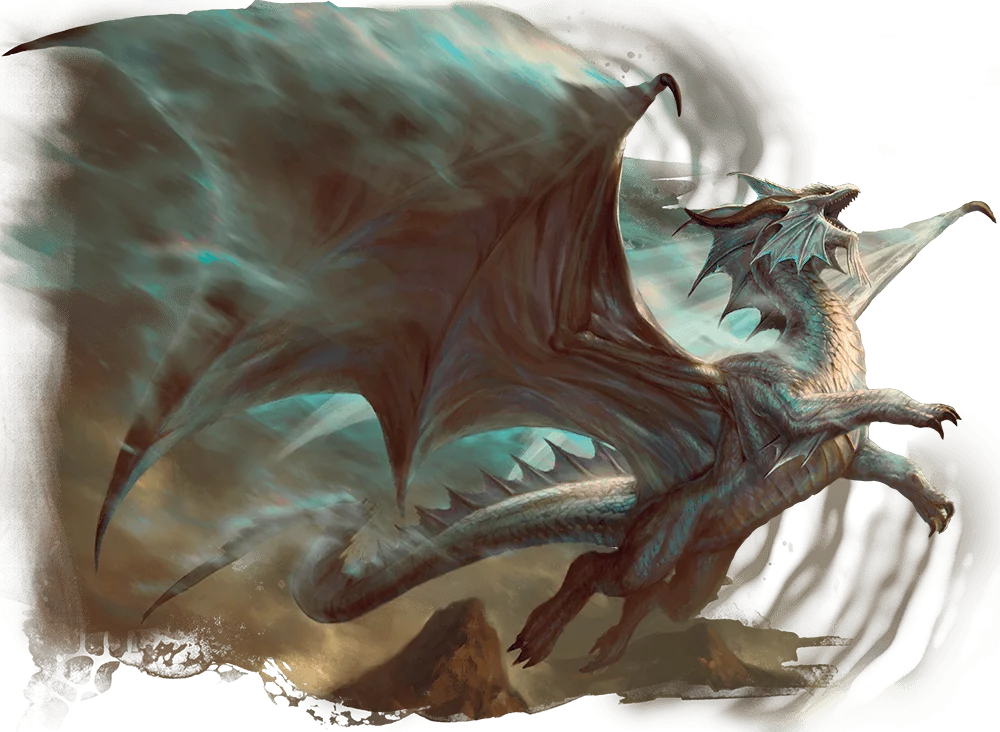
Bahamut, the Platinum Dragon, was the last god remaining after the Starfall. In the teaching of the Synod of the Silver Flame, he gathered the survivors into a walled city in the Silver Vale, and there gave up his life and consciousness to become the Silver Flame, the lasting protection of the city that became Argentum.
Biography
Background
After the Starfall a creeping blight called the Sorrow killed or corrupted everything in its path, including the gods, and Bahamut was the last god remaining. By Argentum’s history he spent ten years gathering people and protecting them on the move, and reached the place that would become Argentum with the refugees ten years after the Starfall.1 A city already stood there, built by dwarves or mostly by dwarves, and Argentum grew out of it.2 He stewarded it for about two hundred years, and in 211 PSF chose to sacrifice himself and become the Silver Flame.1 The Synod calls this the Covenant of the Silver Flame. The city was officially recognized under the name Argentum the following year.1
Session 19
Many of the survivors Bahamut led to Argentum after the Starfall brought seeds with them, and fruits and vegetables from milder climates still grow in the city’s greenhouses.3
Session 21
Leo Anders of the Dragoons of Bahamut wore a sash embroidered with a silver dragon emblem of Bahamut, the kind found on Dragoon armor, on 10 Nightdeep, 1714 PSF.4
Session 22
On 11 Nightdeep, 1714 PSF, the party saw a fang of Bahamut in use, when Seren Eldryn fought them with hers.5
Session 25
Hecate said on 18 Nightdeep, 1714 PSF, that the Ruined Citadel fell before Bahamut arrived in the Vale.6 That night Hazel told Temerity she was pretty sure the dragon who gave Temerity her blessing had horns too.6
Session 28
In the Ruined Citadel on 19 Nightdeep, 1714 PSF, Hazel judged claw marks to be a dragon’s. Dragons belong to legend in the Vale, which talks of only one, and rarely by name.7 Asked whether anyone knew of another dragon in the Vale, Iva named Bahamut: “He’s dead.”7 Luma wondered whether Bahamut had wrecked the Citadel, and later whether the Synod were lying about him.7 Arundil, the ghost of the Citadel’s lore master, remembered Bahamut as one of the gods, but said that some fell after the sky broke and the quiet came, and knew no more.7
Session 29
At camp below the Ruined Citadel on 19 Nightdeep, 1714 PSF, Luma said she thought the story that Bahamut gave the city the Silver Flame at great sacrifice was a lie, though she was not saying Bahamut did not exist.8 Hazel wondered whether Bahamut’s flame was in Temerity, and nowhere else.8
Session 30
On 20 Nightdeep, 1714 PSF, Temerity, who knows what a dragon should look like from the emblems of Bahamut, did not at first take the coiled tail of a black dragon beneath the Ruined Citadel for a dragon’s.9
Session 31
On 20 Nightdeep, 1714 PSF, when Hecate marveled at a dragon in the Silver Vale, Luma pointed out that there had already been one. Hecate answered that Bahamut was a god, a divine being, a little different from a dragon, and that her mentor, Andreth, always spoke of the wondrous Bahamut at the heart of their protection more as a dragon than a deity.10 Andreth taught that the people of the land look to Bahamut for their protection, but that with Bahamut dead it is not wise to hope solely on a light left behind and no longer attended.10 The metallic dragons, bronze and gold and silver and brass and copper, are said to be more akin to Bahamut, the Platinum Dragon, and the chromatic dragons to Tiamat.10
Session 34
On 1 Frosthold, 1715 PSF, Emeric Aelorothi told the party that all he knew of the Silver Flame was that Bahamut sacrificed himself to create it, and that nothing he had learned beyond the Vale contradicted that. Bahamut was a dragon, “so they say”.11
Legacy
A silver statue of Bahamut forty feet tall stands in the Plaza of the Ascendant, at the heart of the Lantern Wards, with the Cathedral of the Silver Flame rising behind it. It is the largest dragon statue any of the party had seen.12 The platinum dragon coin is stamped with his likeness, and the mountains of the Vale stamped on the gold crown are sometimes called the Crown of Bahamut.7
The Synod’s doctrine is focused on community rather than on faith or magic, apart from the acts of Bahamut. As far as Luma knew, there has been no miracle since his death beyond people being blessed by the Silver Flame.1 Hecate spoke of the protection over the Vale as granted by the essence of the dead god.13
The Dragoons of Bahamut bear his name. They receive something called the blessing of Bahamut in place of the blessing of the Silver Flame, and learn the language of Bahamut himself.14
History
Session 9
Crossing the Lantern Wards, the party passed the dragon statue north of the cathedral, which they took to be Bahamut.12
Session 10
In the Underforge Vaults, Hazel told the party that when Bahamut brought the survivors of the Starfall, he brought them to a city that already existed.2
Session 11
Temerity found that the platinum dragons Luma had paid her, stamped with Bahamut’s emblem, had turned to solid copper.15 In Vault 17 the party found a small stone dragon that looked very much like Bahamut among a dwarven family’s abandoned toys. Temerity noted that the child who wrote the note they found there had been alive when Bahamut was there.15
Session 12
Hazel challenged Temerity’s belief that she cannot die: if Bahamut had the power to hold death at bay, would he not have used it for himself?16
Session 13
Luma knew the city’s history of Bahamut’s arrival and sacrifice.1 Finding a ward deep beneath the city, Hazel said that however much she distrusted the church, if Bahamut had put it there she would trust him.1
Session 14
The party learned that the Dragoons of Bahamut receive the blessing of Bahamut rather than that of the Silver Flame.14
Session 16
Temerity told Hazel that what would help her fight the Sorrow was a Dragoon’s fang and the blessing of Bahamut.17
Appearances and Mentions
- Session 9, mentioned
- Session 10, mentioned
- Session 11, mentioned
- Session 12, mentioned
- Session 13, mentioned
- Session 14, mentioned
- Session 16, mentioned
- Session 19, mentioned
- Session 21, mentioned
- Session 22, mentioned
- Session 25, mentioned
- Session 28, mentioned
- Session 29, mentioned
- Session 30, mentioned
- Session 31, mentioned
- Session 34, mentioned
Quotations
- “If Bahamut had the power to hold death at bay, do you not think he would have done it for himself?” Hazel to Temerity.16
Trivia
- In the published worlds of Dungeons & Dragons, Bahamut is one of the primordial dragons said to have created the First World, and is revered as a god of justice and nobility.18
Gallery