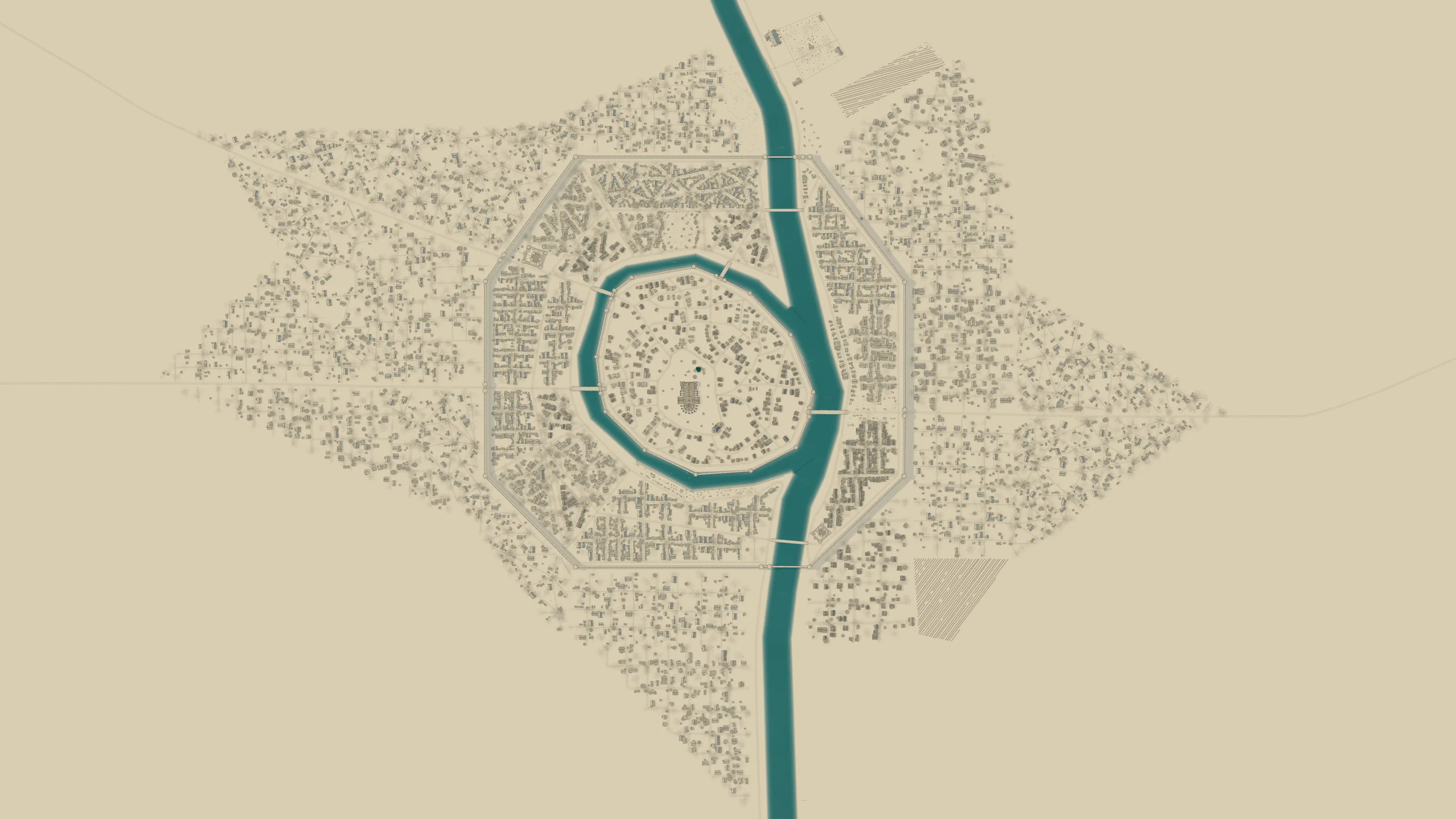
Argentum is the walled city at the center of the Silver Vale, and the seat of what remains of civilization after the Starfall. It is governed by strict law, and its survival is held to depend on the upkeep of its physical and divine defenses. Before it was named Argentum, it was the dwarven city of Sundabar, or Citadel Sundabar.12
Description
The inner city is built of high-quality stonework in a consistent style, plain but expertly made. The Cathedral of the Silver Flame is the exception, being more ornate and set with stained glass. Between the canals and the Hearth Wall the building is more mixed, in cobblestone, brick and wood. The Hearth Wall itself is white stone, fifty feet tall, with watchtowers of seventy-five feet along its length. The city has a moat.3 It is about four thousand feet across from gate to gate, a little under twenty minutes’ walk.4 The Outerworks sprawl beyond the wall, built from whatever came to hand and leaning more to wood than to stone.
Lantern Wards
The Lantern Wards are the upper city, a wealthy district of trade and old stone housing. At its heart is the Plaza of the Ascendant, a broad square holding a silver statue of Bahamut forty feet tall, with the Cathedral of the Silver Flame rising behind it. The Cathedral is the seat of the ruling Synod of the Silver Flame and holds the city’s most vital archives. The Grand Canals, a heated aqueduct system, encircle the ward and supply security, heat and water.
Hearth Wall
The Hearth Wall is the most populous part of the city, between the Grand Canals and the outer wall, which is itself called the Hearth Wall. Life here is practical and varied, and the district holds communal longhouses, artisan quarters and barracks. The Canal Markets trade along the Grand Canals on this side of the wall, from booths and barges selling greenhouse produce, preserved meats and salvaged goods.
Outerworks
Farmland stretching several miles beyond the Hearth Wall, still inside the protection of the Silver Flame and patrolled by the Order of the Lantern. The city’s own graveyards are pretty full, and there are open graveyards beyond the Hearth Wall.5 At night Light Wardens walk its streets with their lanterns. The Stone Shields do not patrol beyond the wall.6
Underforge Vaults
The Underforge Vaults are ancient forges beneath the city, worked over a single volcanic rift called the Everfire, which supplies the city with heat, power and industry. The city’s coins are minted there.
Society
Arcane magic is forbidden in Argentum and throughout the Silver Vale. The Synod of the Silver Flame teaches that arcane hubris called down the Starfall, and those who show arcane talent are taken by the Order of the Lantern for purification. The Order does not say what purification involves, and those taken are rarely seen again. Divine and primal magic are accepted, and divine casters draw their power from the Silver Flame itself.
The city is warmed and lit by the Everfire system, which feeds heated canals and glass lamps filled with molten material. Most food comes from the Outerworks and the farmland of the Vale. Greenhouses all over the city grow fruits and vegetables from milder climates, from seeds that survivors of the Starfall brought with them, and elsewhere in the Vale these are found only when someone buys them in the city.7 Public festivals are frequent, and communal meals in the Hearth Wall district serve as both social occasions and demonstrations of the Synod’s providence.
Currency is minted by the Vaultsmiths: platinum Dragons, gold Crowns, silver Embers and copper Anvils. The copper anvil bears the Vaultsmiths’ emblem.8 The meaning given to the coins is common knowledge. The dragon depicts Bahamut, and the ember is the mote of the Silver Flame. The crowns bear no crown but a mountain range, since the mountains that surround the Vale are sometimes called the crown of Bahamut.2 There is no tipping in Argentum.7
Orcs and half-orcs live in the city, and are more common than elves or dwarves.3 Dwarven families still mark their doors and signet seals with traditional clan marks, though less often than they once did.3
Argentum has five patrician houses: House Ashford, House Draken, House Marwin, House Sterling and House Valerius. They are not official nobility, though they consider themselves nobility, and they are very well placed in the city’s infrastructure.9
Citizens carry papers that amount to a birth certificate, which must be shown to cross the bridges into the Lantern Wards.8 The guards at the city gates hardly check papers, but they do ask anyone leaving at night about their business out of the city.5 The gates are kept shut at night, and raised on chains.6 Sewer covers are usually locked with a simple lock.9
Cremation is the rite of the Silver Flame, and the Synod advocates it, mostly because space is at a premium, but many people are buried by tradition.5
The Silver Vale has no law against dealing with devils, since it is unheard of. Invoking, summoning or contracting with devils would be met with the full force of the Synod.4
History
The Starfall is dated to roughly seventeen centuries ago in the teaching of the Synod of the Silver Flame. Bahamut gathered the survivors into a walled city in the Silver Vale, and there performed the Covenant of the Silver Flame, giving up his life and consciousness to become lasting protection for the city.
The city was not built from nothing. When Bahamut brought the survivors of the Starfall and the Sorrow that followed, he brought them to a city that already existed, built by dwarves or mostly by dwarves, and Argentum grew out of it.1 The dwarven work still shows in the architecture at the heart of the city and in the Underforge Vaults, while everything in the Hearth Wall district was built after the Starfall.1 Hazel supposed the city had another name before it was named for the Silver Flame, and it was Sundabar.12
What counts as the start of Argentum is a matter of scholarly debate. Bahamut arrived with the refugees ten years after the Starfall, after ten years of gathering and protecting people on the move, and stewarded the place for about two hundred years. In 211 PSF he chose to sacrifice himself and become the Silver Flame. The city had been growing since his arrival, but it was officially recognized as operating under the name Argentum the next year, 212 PSF.10 Kasem Aroon has been told that his family came up to the city in the Great Migration from the South, when Argentum was first founded.5
Sundabar
Before it was named Argentum, the city was Sundabar, or Citadel Sundabar, a dwarven citadel. Arundil, the ghost of the lore master of the Ruined Citadel, called it that citadel’s sister city, and told the party about it on 19 Nightdeep, 1714 PSF.2 Sundabar is a Dwarvish proper noun, with no literal translation.2
Sundabar was walled on its surface: a moat, then a wall, then the city, and at its heart the circle, which is named in the words “Orcs in the Circle” on a wall of Vault 18 (Vault 18 graffiti).32 Below it lay the proper city where the dwarves lived, with great forgeworks built on their great underground fire, the Everfire. It let them make powerful magic weapons and other items more easily than others could.2 The Ruined Citadel, then Citadel Felbarr, traded with Sundabar by the Fardrimm for its magic weapons, and its own craft, Arundil said, was at best an echo of what was made in Sundabar.2 The Citadel’s library holds surveys of dangerous encounters on the Fardrimm between the two.2
By Arundil’s account, Sundabar fell in the same orc war that sacked the Citadel, and was restored in the years that followed. The rebuilding was quite grand, before the sky shattered.2
Session 25
Hecate said on 18 Nightdeep, 1714 PSF, that Argentum is sometimes called the Last City, and that before the Starfall Aerasumé dwarfed it many times over.11 The people of Aerasumé would probably try to kill anyone who told them they came from Argentum.11
Session 28
Arundil could not at first recall the name of the Citadel’s sister city, some fifty miles to the southwest, only that it had something to do with light or day and sounded like Everfire Splendarr. When Temerity put “Sun” and “Splendarr” together as “Sundar”, he remembered it: Citadel Sundabar.2 He did not know of the powerful presence Luma had felt at the center of the city, above the entrance to the Fardrimm.2 Hazel wondered whether the coins’ names stood for places, and whether a citadel to the north might be an anvil.2
Session 33
The party came back to Argentum from Erhadell around midday on 29 Nightdeep, 1714 PSF, the third day on the road, with heavy snow falling.12 At the outer Hearth Wall the snow began to lighten in the warmth that pours out of the city, and the air grew warmer with every step in.12
Session 34
On 1 Frosthold, 1715 PSF, Emeric Aelorothi told the party that most people beyond the Vale do not know Argentum exists, and that if they did, they would probably come, and would probably not be welcome. He did not know why anyone would leave it except to fight the Sorrow: if safety is what someone wants, he said, it is the best place in the world to be safe from what is out there.13
Points of Interest
Everfire Lamps stand throughout the city, glass pillars fed from the rift below. One of them erupted in a geyser sixty feet high during the Festival of Bells, scattering burning Everfire across the plaza.14
The Footlight Theater in the Lantern Wards is the city’s largest theater, and its Synod-sponsored center for the performing arts.4
Map