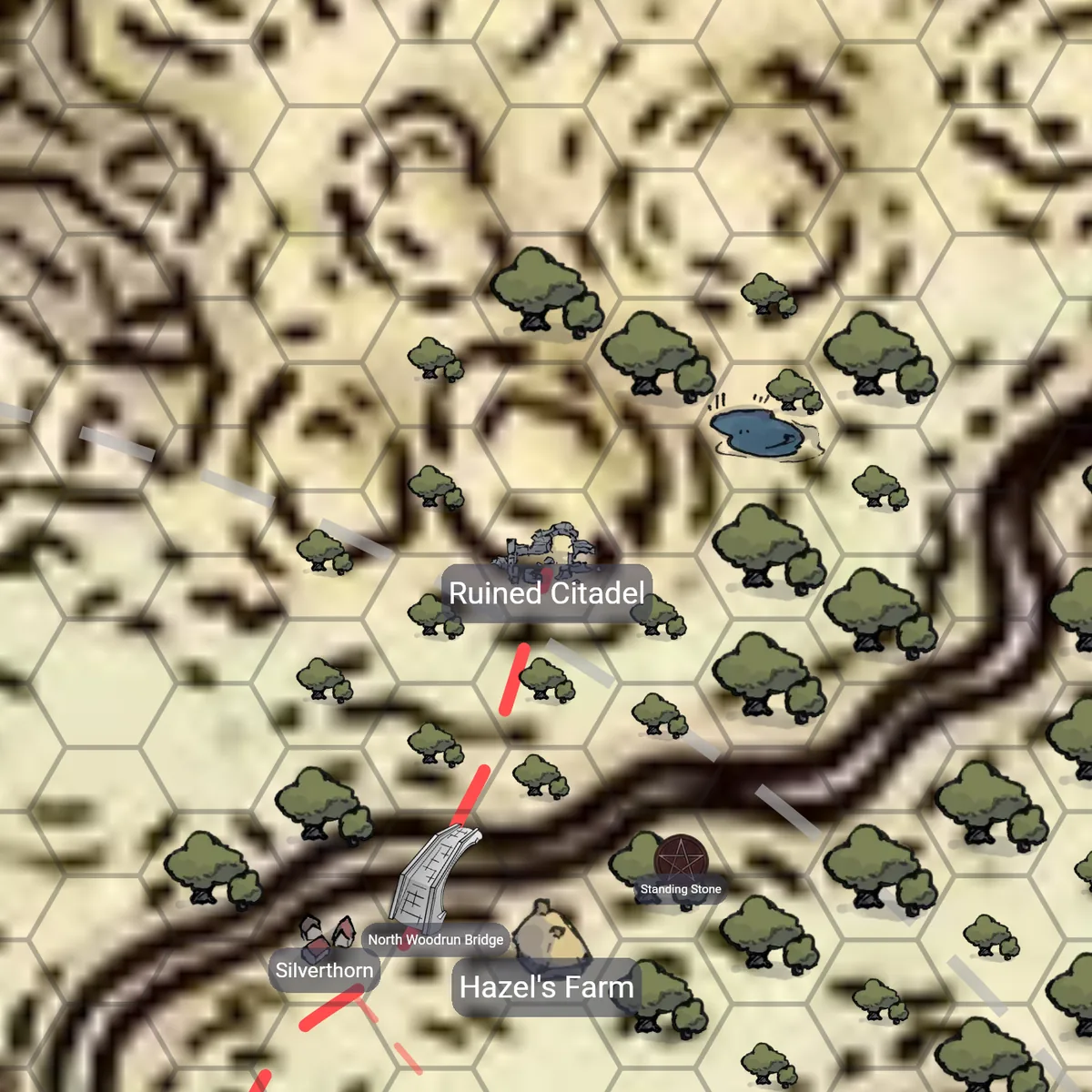
The Ruined Citadel, once called Citadel Felbarr, is the ruin of a fortified dwarven settlement on a hill north of Silverthorn, not far from where Hazel grew up and outside the protection of the Silver Vale’s watchtowers and the Silver Flame.12 It was the seat of Clan Warcrown, and traded by the Fardrimm with its sister city, Sundabar, now Argentum.3 As far as Hecate understands, it fell before Bahamut came to the Vale, and it has never been retaken.2 The ghost of its lore master, Arundil, told the party that its dwarves died of a creeping quiet that came up the deep road after the sky broke.3 It was a military fort that dealt with invaders several times in its history.4 Hazel was forbidden her whole life to go that far out. Once you get far enough out, she said, you start hearing things that aren’t there.1 The party explored it on 19 and 20 Nightdeep, 1714 PSF. Its gate halls were held only by the dead: dwarves who had died at their posts with no wound on them, and an undead Warden, who asked who stands the watch.5 In the natural caverns below, where the Citadel’s dwarves lie in stone sepulchres, the party met stirges, gricks, an owlbear and a giant subterranean lizard.4 In the halls above them they found Arundil, who told them the Citadel’s story before they laid him to rest, and learned that a dragon, the black wyrm of the deep lake, had taken its treasure.3 At the very bottom of the Citadel, in a great lake beneath the caverns, that dragon, Nightscale, sleeps under the water beside her hoard.6
Description
The road north from Silverthorn crosses the Woodrun River by an old, unmaintained bridge, and ends at the Citadel.2 In the fields around the bridge stand uncarved river stones set upright over graves, raised in haste at the site of a battle hundreds of years ago.2 Beyond the bridge the forest thins toward the foot of the mountains, and the road climbs a hill some 1,400 feet high, with the ruins of walls reaching out from it like arms.2 At what was once the gate of the Citadel’s surface town stand a couple of dozen ruined, moss-covered stone buildings, and the road passes two ruined watchtowers where the wall once stood. It zigzags up the hill until the trees thin and the hilltop turns to bare rock, and the path, carved in dwarven stone, disappears into the rock above.2
The stonework is clearly dwarven, very like the older parts of Argentum in style and material, though the Citadel has far less of a surface presence.5 Its floors, even in the natural caverns of its upper halls, are carved into tiled brick.4 The fort kept traps that everyone in it knew about and invaders did not.4
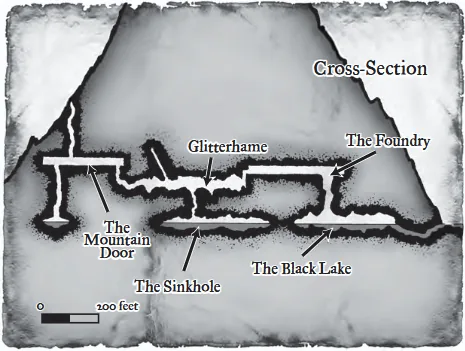
Hecate has been to the surface, and saw a passage into deeper levels, but felt no desire to go down. How deep it goes she does not know: it could reach the base of the hill or further.2 She has long believed that something old and dangerous festers at its roots.2 It connects to the Fardrimm. Its dwarves traded by the deep road, and moved the doors of their gate below, as the Runegate, to hold it shut.3
The Gate
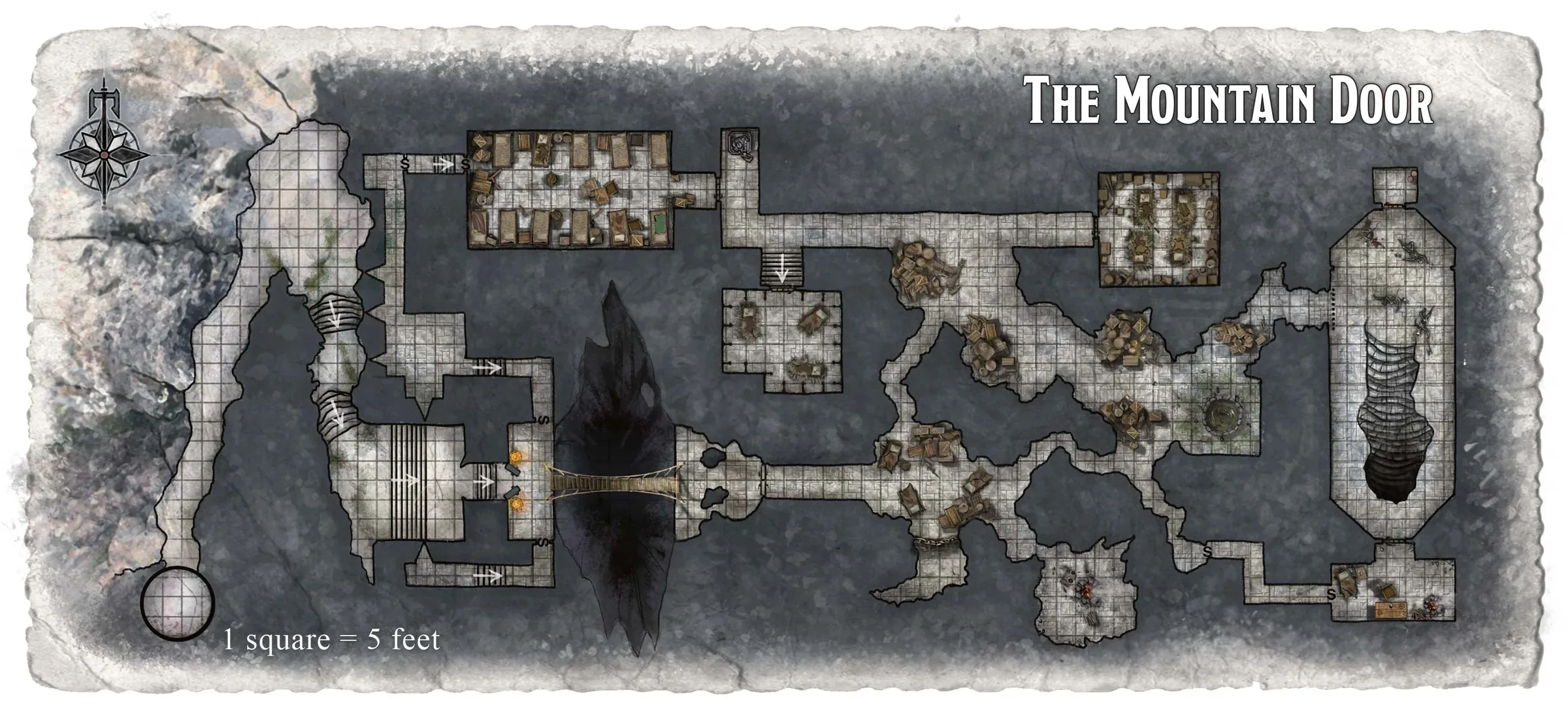
The path up the hill is carved into the rock face, with a long drop on one side and sheer rock on the other, and arrow slits carved to look natural are cut into the rock along its last stretch.5 It ends at a wide ledge littered with old debris, bits of char and bone and the staves of rotted casks, and shallow steps lead up a steep fissure to the gate.5 There a broad entryway is carved out of the stone, with an inset frame for doors twenty feet square. The frame stands empty. The great stone doors were chiseled from their hinges in a hurry and carried away, and are nowhere to be seen.5
The doorway opens into a large hall cut in two by a deep, dark crevice, spanned by a frayed, thin rope bridge, with water rushing somewhere far below and cold copper braziers, green with age, on either side of the door.5 Secret doors in the hall lead to hidden archers’ posts on either side of the entryway, lit only through their arrow slits; one opens when two loose stones in the wall are pressed at once. Dwarven skeletons in corroded mail sit slumped beneath the slits, and nearly everything left in the posts has rotted or corroded.5

The Bunk Room
A better-hidden door, worked by a lever, leads on from the second archers’ post to a very large bunk room.5 Dwarven dead lie composed in several of its bunks, their boots set together on the floor beneath them, with no sign of what killed them.5 Luma sensed the ambient magic of the place pooled around four of them, closest to necromancy.5 Beyond it a statue of a fierce-looking dwarf with a sword and a smith’s hammer stands over a pressure plate, and sprays poison gas from its mouth when the plate is stepped on.5 A short stair past it leads down to the chamber of the Warden, behind an iron-bound door stamped with a crown.5
The Storerooms
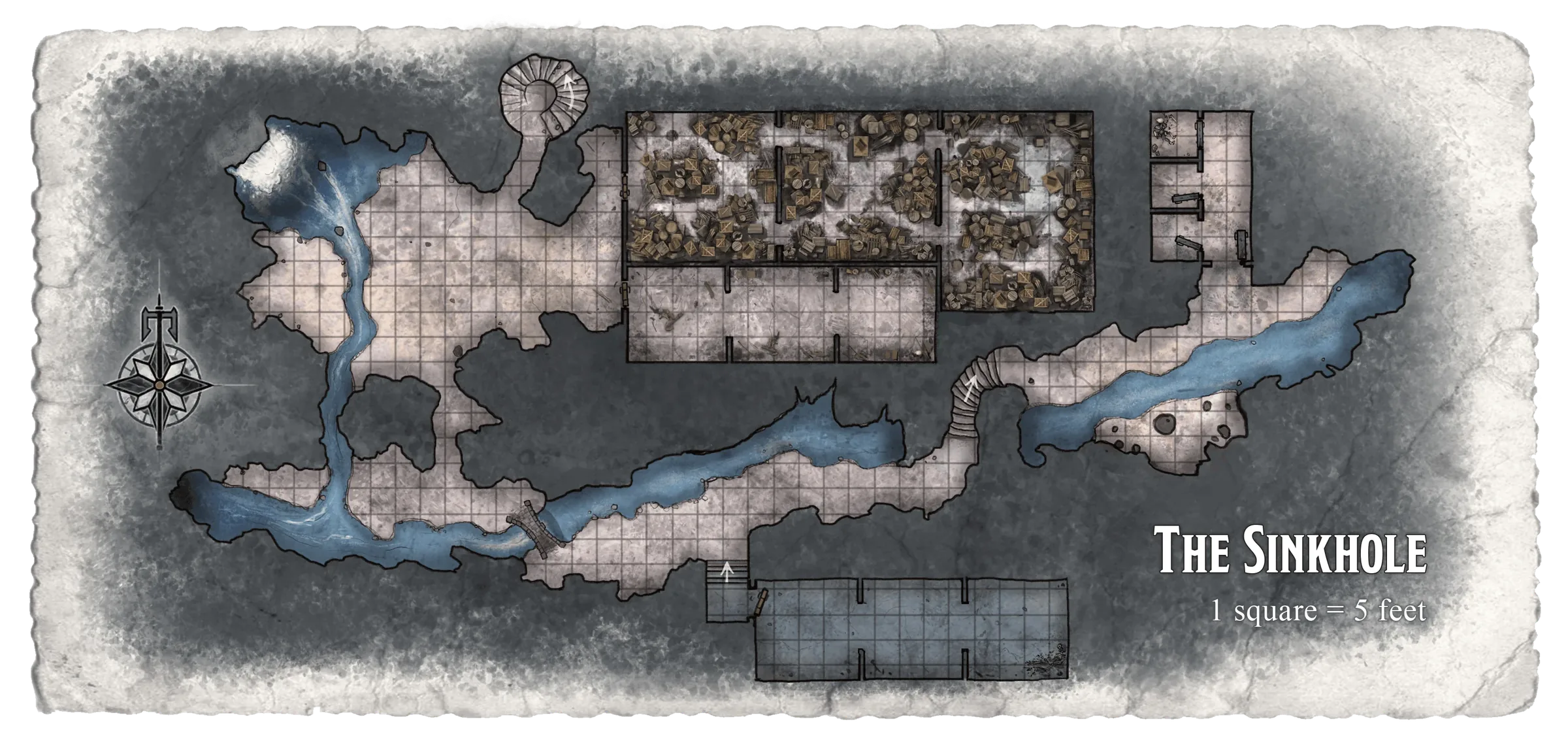
A long natural cavern holds the Citadel’s stores, crates, barrels, sacks and bundles slumped and burst with age, and siege equipment including a ballista, all fallen into disrepair.5 In it is a well overgrown with cave moss. Its stone lining gives way to a natural shaft that runs far down, with a current at the bottom; if it reaches the level of the river, it is a thousand feet deep at least.5 In a smoothed cavern beyond, behind a rotted door, is a camp someone made and never struck, where the party found the Silverthorn journal.5 Double stone doors to the west of that cavern open on the far side of the chasm, so that the level wraps around.4
A kitchen off the stores holds a great cooking hearth, dead and cold, and battered pots and kettles stacked under dust, and a steady draft is drawn up through a rough hole in its ceiling.4 A second barracks nearby, with more storage than the bunk room, held four dwarven skeletons composed as if in sleep, and a rack of four Warcrown battleaxes.4 The way east from the stores, barricaded with crates and barrels, ends at an iron gate that swings open on a lock long rusted over.4
The Grand Stair
Beyond the iron gate is a chamber whose ceiling soars thirty feet at its center, its walls carved with images of dwarves at their forges.4 In the center of its floor a natural rift descends sharply, with dozens of stone steps leading down into the dark, to the caverns below.4 Dwarf-sized skeletons lie scattered across the floor, in what is left of practical civilian clothing, with hints of leather aprons and tool belts.4
The chamber’s north door is carved in the image of a glowering dwarf’s face, with eight small spouts worked into the stonework beside its hinges. A counterweight inside the door and wall sprays a flammable liquid from the spouts when the door opens, fed by pipes from two twenty-gallon copper drums in a small room behind it that exists only to hold the trap.4 The charred skeletons of two orcs who invaded the fort lie in front of it.4 The chamber’s other door opens on a room of finished stonework, bare and orderly under its dust, with a stone desk, a cot, a cold fireplace and tattered heraldry on the walls.4 Under a floor stone behind the desk was a hidden compartment holding a belt of dwarvenkind and a bottle of Everfire Splendarr.4
The Caves Below
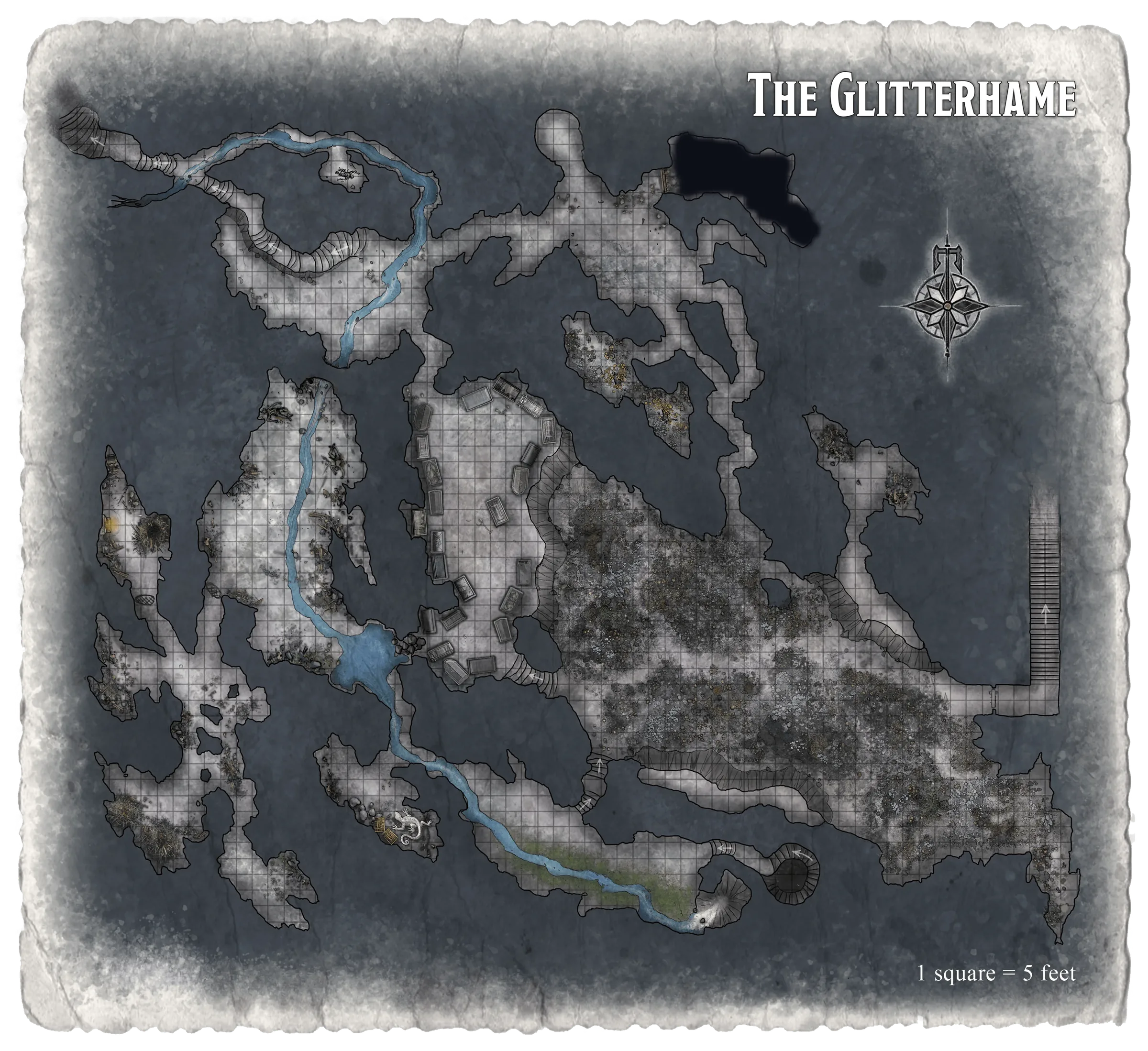
The natural caverns below the Grand Stair are called the Glitterhame.3 The stairway from the rift twists a long way down, its floor cut into hundreds of shallow steps and its walls and ceiling natural rock. Some sixty feet down, a rushing stream crosses it from a crack to the south.4 In a narrow alcove off the stream’s tunnel, stirges roosted over the drained body of one of the salvage party who camped in the Citadel.4 The stream runs on into a very high cavern, its ceiling forty feet or more overhead, and out under a low stone overhang to the south.4

The Sepulchres
An extremely large cave, dimly lit by natural phosphorescence, holds the sepulchres of the Citadel’s dwarves. Crystals glimmer in it, weird, beautiful flows and structures of delicate stone grace the chamber, and its ceiling rises fifty feet in places.4 Twenty-three large stone sepulchres line the walls of its western part, which stands on a steep bluff twenty feet above the rest of the cave. Their lids are carved in the likenesses of grim dwarves in armor, and Dwarvish runes on the front of each name its occupant or intended occupant.4 Three carry more runes, recording the dates of death and the great deeds of Borgol the Old, Gharin Orc-Doom and Numik the Unlucky, and a warning that doom awaits any who dare defile the honorable dead.4
Stairs lead down the bluff to the lower cave, and a crevice leads to a cavern where the stream widens into a pool about twenty feet across and ten feet deep.4 Across the stream is the den of a giant subterranean lizard, with the bones of its meals along the western wall.4 Further on, the roar of falling water fills a long, low chamber, slick with spray, where the stream runs from beneath a crude dam of rock and mud and disappears into a dark shaft. Its floor on one side is coated in a thin layer of green slime and slopes steeply toward the fast water.4 Beside the shaft, carved stairs spiral sixty feet down to another level, where a narrow passage opens into a larger natural cavern loud with rushing water.3
The Great Cavern
A great cavern below the sepulchres glimmers with faint phosphorescence under a ceiling almost fifty feet high, with bright flecks and gleaming stone formations in the distance.4 Strange fungi dot its floor: capped stalks as tall as a person, which are just mushrooms, and glowing puffballs almost a yard wide, which are edible.4 High ledges rise fifteen to twenty feet on its north, south and west walls, carved stairs lead down from the western ledge to a path that meanders to a small iron door in the eastern wall, and a soft, cool breeze sighs through it, rising toward the surface far above.4 Above the path a rockfall about twenty feet high spills from a rocky ledge.4 The side cavern beyond the ledge was the gricks’ lair, piled with bones, refuse and fungi.3 The iron door is five feet tall and four wide, of riveted iron plates turning on a pintle through its middle, and bears a tarnished silver rune, the forge mark of the Citadel’s smiths. Stairs behind it climb to the Foundry.3
To the north several passages branch from a high-ceilinged cavern, where a carved, square-mouthed tunnel, cruder work than the dwarves’, shows that someone else has worked these caves. It smells heavily of animal, and an owlbear dens there.4
The Lower Caverns
The stairs beside the shaft end in a larger cave. A loud waterfall spills down its northwest wall into a deep pool, the rocky walls glisten with spray, and a weird array of colorful minerals and strange lichens lend it an unearthly beauty.7 A fast-moving stream runs south from the pool, with a natural passage beside it heading the same way, and a set of narrow stairs cut into the rock winds up the wall to the north. Nothing lies behind the waterfall.7
Two old wooden doors in a wall of dressed stone to the east open on the Citadel’s old storerooms. The northern door leads to a low chamber of dressed stone filled with rotten food: barrels of salted meat gone bad, sacks of flour and grain covered in russet-colored mold, and tuns of cider turned to vinegar. Archways lead east to two more such rooms.7 A gray ooze lived in the middle room, and what had not rotted in the stores it dissolved over time.7 The southern door sticks, and beyond it are empty storerooms, much drier, perhaps never used, or emptied by the salvagers.7
The River Caverns
The passage beside the stream leads to a long, narrow cavern half filled with a fast underground river. A narrow ledge on the north side overlooks the river, and a sturdy stone bridge spans it to a larger ledge on the south that follows the river east.6 Pale cave fish swim in it, and it runs on through a narrow gap with no air above the water.6
Stairs lead up from the cavern, and beside them a wooden door opens on a short flight of stone steps down to a second door. The room beyond is flooded with five feet of dark, stagnant water, murky and reeking of rot, that would make a normal person very sick to drink or wade through.6 Its ceiling leaves ten feet of air above the water, and at the bottom lay the skeleton of a dwarf on a rotted leather pouch.6

The stairs climb steeply, turn north and descend east into a second river cavern, smaller than the first. A ledge along the river runs east to a door in the north wall, and the river separates it from a ledge on the southern side.6 A roper waited on the southern ledge, looking like a large, strange stalagmite, until the party killed it, and on the ledge lay a pair of old leather boots with the bones of someone’s feet still in them.6 Behind a sturdy door of iron plate in the north wall, a short passage has three small iron cells in its west wall.6 The last was locked, and held the skeleton of someone of dwarvish stature, forty-one tally marks carved into the wall behind him, an oversized Warcrown coin in a silk purse, and, on a cord around his neck, the key to the iron door below the Foundry.6
The Foundry
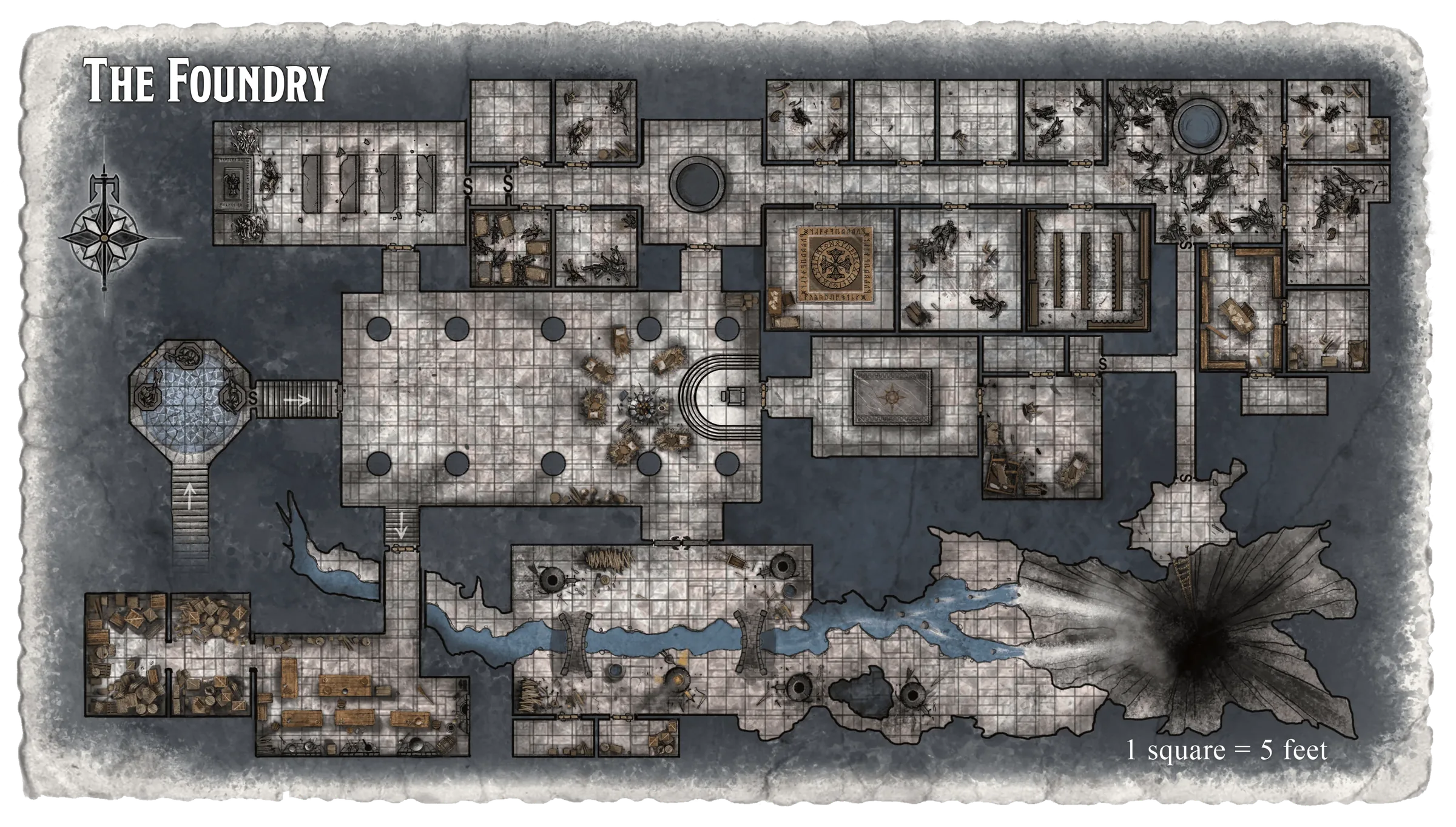
The Foundry is the level of carved halls above the Glitterhame, where the Citadel’s dwarves lived and worked, and where the wreckage of their last defense still lies.3 Its dead lie where they fell, and some of them fought Sorrowsworn, whose wrong-jointed frames of bone lie among them.3 Its mechanical traps still work, but the magic of Arundil’s defenses went still when he was laid to rest.3

The stairs from the iron door end at an octagonal chamber floored with cracked, dusty blue tiles, its walls dressed with polished marble and its ceiling a dome thirty feet high. Three cast bronze statues of armed dwarves, almost ten feet tall, stand by its walls.3 Its two doors of iron-bound oak open on bare stone, and opening either one drops the axes of the two nearest statues into the space in front of it.3 A button behind one statue opens a hidden stair, and halfway up, a mouth forms in the stone and screams in Dwarvish: “Alert, alert, intruders approach.”3
The Pillared Hall
The hidden stair opens on an enormous hall lined with ten great pillars carved into the forms of giants and dragons, under a vaulted ceiling, with a mighty throne on a dais at its far end and cold sconces along its walls.3 Its tile mosaics have been smashed and raked through by claws, and a battle was fought there: the defenders formed a line around the throne and were pushed back toward the doors by something that came from the halls to the north and east.3 Where Luma mended it, the mosaic shows dwarves in armor bearing dwarven-made axes around a kingly dwarf crowned with a golden crown set with three sapphires.3
Behind the throne is a small audience chamber with a table made of a single stone slab and old tapestries on its walls.3 Beyond it is a bedchamber, where a sleeping platform, a table, a bench and a writing desk have all been gouged, scored and partly burned. It has a bathing area with two clay tanks for wash water, and a closet of mildewed cloaks, behind which a movable panel opens on a narrow escape tunnel. Levers in the tunnel work secret doors back into the bedchamber and out onto a ledge above the chasm.3
The Bladeworks
Double stone doors from the audience chamber lead into the old dwarven bladeworks, a barrel-vaulted forge of dark furnaces with a great anvil before a cold forge.3 A stream runs west to east through its middle under two stone bridges, and its eastern end opens into a large, dark cave from which a cold wind moans.3 Beyond, the stream tumbles into a great chasm 120 feet deep, and a chain ladder runs down its side from a small ledge.3 At the bottom the waterfall falls into a pool, and the ladder reaches a sizable area of solid ground.6 The forge’s racks held weapons, and a reading stand beside it held Arundil's Smithing Book.3 Two doors to the south open on storerooms.3
The Halls to the North
North of the audience chamber, a chamber with a dark pool at its center opens on hallways lined with doors. Most of the rooms were living quarters, drawing rooms, barracks, armories and storerooms, and hold smashed furniture and the remains of the dead.3 In one, six skeletons lie on six beds with their weapons.3 The personal quarters of an important dwarf were left untouched, with tapestries, a rug of smothering twenty feet square covered in magic runes, and an unfinished letter in Dwarvish, dated in Common “Marpenoth 11, 1500”.3 In an armory of empty racks stands an animated armor that did not stir.3 A larger chamber at the east end, with a dark pool in a low stone basin, holds seven dwarves where they fell, and the frames of the things they fought.3
A library at the far end holds histories of the hold and its line, ledgers of trade down the deep roads, and surveys of the Fardrimm, many of them destroyed beyond reading. A scholar’s sleeping quarters adjoin it.3
The Shrine
The walls of the Citadel’s shrine are carved with the dour images of dwarves, and deep claw gouges cross the icons of the gods. Its benches have been smashed, and on a low stone altar at the western end lies the ancient corpse of a dwarf warrior with his arms folded over his chest, bones heaped around him.3
The Kitchen

Stairs lead south from the pillared hall to a kitchen lined with hearths, its pots, pans, cauldrons and kettles scattered across the floor and tables, with a pantry of rotted food beyond. One of its tables is carved underneath, all along its edge, with dwarven runes, and was one of Arundil’s guardians.3
The Deep Lake
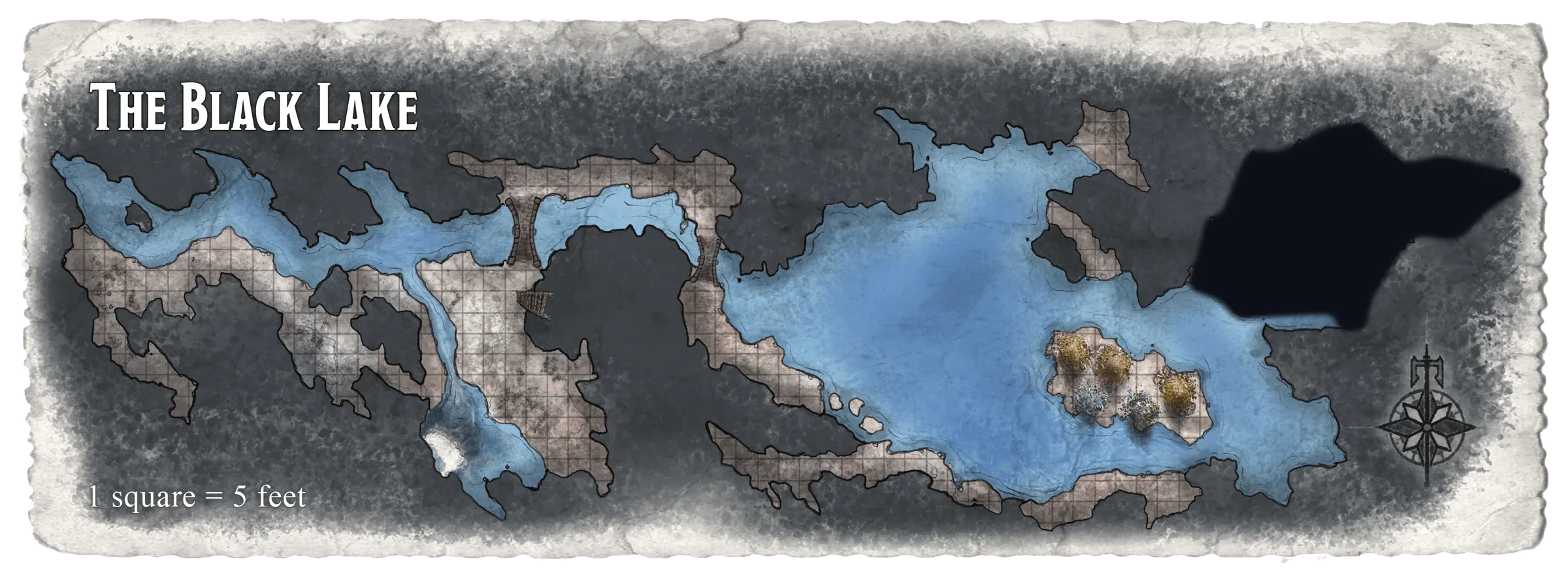
A thundering spray of water fills the foot of the chasm, pooling and flowing out to join a larger river to the north, and the roar of the waterfall is deafening.6 The muddy bank of the pool was disturbed by the tracks of something very big, walking on four legs, which Hazel could not identify.6 A broad ledge runs north to the river, where a sturdy stone bridge of dwarven make crosses it, and beyond it the ledge runs east and bends south to a second bridge. That one is structurally unsound, with a support missing and its stone oddly porous.6 Many little offshoots of the ledge are dead ends.6

Past the second bridge a ledge winds southeast beside a very large lake, apparently the source of the underground river, in a cavern so large that its far shore is lost in shadow. The lake continues off to the northeast, the ceiling over it is about 120 feet high, and a strange cold hangs over it.6 A short way offshore is a small isle thirty to forty feet across, with stalagmites thrusting up at the ceiling above it, piled with broken tables, barrels and crates and glittering with gold and silver.6 It is the hoard of Nightscale, the black wyrm of the deep lake, who sleeps deep under the water beside it.6
History
Clan Warcrown held the Citadel under its kings, and traded by the Fardrimm with Sundabar for magic weapons.3 Centuries ago an army of orcs sacked it, and a great orc chieftain took the entire Silver Vale before he was routed and killed. The dwarves retook the fortress and built the Runegate.3 One of its kings, Emerus Warcrown, abdicated his throne in 1486 and left on what the Citadel’s histories call “the Warcrown’s grand expedition”. By Arundil’s account, the sky broke a few years after the orc war, and a creeping quiet came up the Fardrimm. The dwarves moved the Runegate below, but most of them lay down where they stood and stopped being alive, and Arundil kept the forges and the defenses alone.3 Once everyone was dead, Nightscale, the black wyrm of the deep lake, came up for the Citadel’s treasure.3 Before the party, the last living souls to come there were the salvagers from Silverthorn, some ten years earlier.3
Session 14
On 1 Nightdeep, 1714 PSF, the party found that Eliath Drace’s sketch of a grove is a map of the Silver Vale. A rock on it, identical to one far beyond the Vale, marks the Ruined Citadel.1 Hazel told the others she had wanted to explore it all her life, and Luma thought the sketch a good excuse to go and look.1
Session 24
The party put off leaving Argentum by two days in the middle of Nightdeep, 1714 PSF, so that they would have time to visit the Ruined Citadel on their trip north, and meant to set out from Crick's Bend on 18 Nightdeep for Silverthorn, and perhaps the Citadel.8
Session 25
At the Sisters' farm on 18 Nightdeep, 1714 PSF, Luma showed Hecate the rock that marks the Citadel on Eliath Drace’s sketch. Hecate warned Hazel that the place was long abandoned, outside what meager protection the Silver Flame offers so far from Argentum, and incredibly dangerous, but did not tell her not to go: it would not do, she said, to abandon her pack.2 The party set out before dawn the next morning and began the climb.2 Beyond the Vale’s protection each of them felt the Sorrow for the first time, a feeling that the place was dead and belonged to the dead, and each held against it in their own way.2
Session 26
On 19 Nightdeep, 1714 PSF, the party climbed to the gate and found its doors carried off.5 In the archers’ posts beside it they found two weapons that had not rotted or corroded, Watchman's Gift and the Deepwatch Crossbow.5 They went on by a hidden passage to the bunk room, where Luma sensed a necromantic pull around the dwarven dead, and past the gas trap, which Iva’s charcoal mask held against, to the Warden’s chamber.5 The Warden asked who stands the watch, and when Luma took it up, he sat down and was still. Temerity took his greataxe, Homecoming.5 In the storerooms Beepo was lowered fifty feet down the well without reaching the bottom, and in the cavern beyond the party found the abandoned camp and the journal.5
Session 27
Later on 19 Nightdeep, 1714 PSF, listening in the stillness of the camp, Hazel had a brush with the Sorrow, thinking that this was what would happen to her home.4 In a second barracks Luma took four Warcrown battleaxes, and past the iron gate the party fought off stirges that came up the Grand Stair.4 Luma disarmed the fire-trapped door, and behind the desk that the salvagers’ journal mentioned she found the belt of dwarvenkind, which went to Iva, and the bottle of Everfire Splendarr.4 After a rest at the camp the party went down the stair. Hazel killed a roost of stirges over the body of one of the salvage party, and took a hunter's knife from it.4 They passed the sepulchres and left them alone, and Hazel and Luma took two chests from beside the sleeping lizard, which held coin and a potion of water breathing.4 Hazel remembered a story Hecate had told her as a child, of four friends from Silverthorn who came to the Citadel for treasure ten or fifteen years before and never came back, and took them for the salvage party.4 In the great cavern the party backed away from the owlbear, and killed two gricks that ambushed them from the rockfall.4
Session 28
Later on 19 Nightdeep, 1714 PSF, the party climbed from the great cavern to the Foundry. The statues’ trap caught Temerity, and Luma found the hidden stair.3 In the pillared hall Hazel judged the claw marks a full-grown dragon’s, and worked out that the Citadel had been stripped of its treasure long before the salvagers came.3 At the forge the party met Arundil, who named the Citadel’s sister city, told them of the orc war, the quiet and the black wyrm, and said the dwarves’ dating system changed hundreds of years before the Starfall. He wrote Luma a spell scroll of glyph of warding for her promise to look after the Runegate, and was laid to rest.3 Luma took his smithing book, with its formula for dragon scale armor, and an unfinished greatsword from his forge.3 In the library the party learned the Citadel’s name, Citadel Felbarr, and Luma took six of its books. In the shrine Iva took the plate armor of the dead warrior on the altar, and two more of the salvage party lay dead at its foot.3 The party left the Citadel to camp in the woods.3
Session 29
The party camped in the woods below the Citadel on the night of 19 Nightdeep, 1714 PSF, and came back the next morning.7 On the path outside they found the salvagers’ cart, overgrown but twenty years old rather than two hundred, and loaded it with a hundred pounds of iron in bars from the Foundry.7 They crossed the slippery cave on a rope, went down the stairs beside the waterfall to the lower caverns, and found the old storerooms. In the middle storeroom a gray ooze attacked them, and they killed it.7
Session 30
On 20 Nightdeep, 1714 PSF, the party explored the river caverns beyond the waterfall. They killed a roper, found a dead dwarf in the locked cell with a coin and a key, and left the flooded room to Beepo, who brought up a potion of healing and a potion of water breathing.6 The key opened the iron door below the Foundry. From the bladeworks the party climbed down the chasm under Hazel’s pass without trace, Rhysaene on the wall with spider climb and the rest on the ladder.6 At the lake they found Nightscale asleep beneath the water, and left the Citadel without waking her.6 They had come out of it with more of value than they had collected in all their time in Argentum, without counting Iva’s plate armor.6 Crossing back into the Silver Flame’s protection on the way to the Sisters' farm, they felt a weight they had not known was there lift from their shoulders, though for Hazel and Iva it stayed.6
Session 31
At the Sisters' farm on 20 Nightdeep, 1714 PSF, Hecate said she had figured some haunting might be one of the Citadel’s dangers, and that the Order has never sent its people that far.9 She believed the lake past the Citadel was a little swamp-like, but fairly ordinary.9 The party left the salvagers’ cart behind, and put the Foundry’s twenty iron bars into Luma’s bag of holding.9 They meant to come back to it later.9
Trivia
- The Ruined Citadel is adapted from The Forge of Fury, the adventure in Tales from the Yawning Portal.4 That version is itself a fifth-edition update of an older adventure, Richard Baker’s The Forge of Fury, first published in 2000 for the game’s third edition.10
Map
References
Footnotes
-
Session 28 ↩ ↩2 ↩3 ↩4 ↩5 ↩6 ↩7 ↩8 ↩9 ↩10 ↩11 ↩12 ↩13 ↩14 ↩15 ↩16 ↩17 ↩18 ↩19 ↩20 ↩21 ↩22 ↩23 ↩24 ↩25 ↩26 ↩27 ↩28 ↩29 ↩30 ↩31 ↩32 ↩33 ↩34 ↩35 ↩36 ↩37 ↩38 ↩39 ↩40 ↩41 ↩42 ↩43
-
Session 27 ↩ ↩2 ↩3 ↩4 ↩5 ↩6 ↩7 ↩8 ↩9 ↩10 ↩11 ↩12 ↩13 ↩14 ↩15 ↩16 ↩17 ↩18 ↩19 ↩20 ↩21 ↩22 ↩23 ↩24 ↩25 ↩26 ↩27 ↩28 ↩29 ↩30 ↩31 ↩32 ↩33 ↩34 ↩35 ↩36 ↩37
-
Session 26 ↩ ↩2 ↩3 ↩4 ↩5 ↩6 ↩7 ↩8 ↩9 ↩10 ↩11 ↩12 ↩13 ↩14 ↩15 ↩16 ↩17 ↩18 ↩19 ↩20
-
Session 30 ↩ ↩2 ↩3 ↩4 ↩5 ↩6 ↩7 ↩8 ↩9 ↩10 ↩11 ↩12 ↩13 ↩14 ↩15 ↩16 ↩17 ↩18 ↩19 ↩20 ↩21 ↩22
-
Tales from the Yawning Portal, “The Forge of Fury”. ↩