Elvish is the language of elves, one of the standard languages.1 It is fluid, with subtle intonations and intricate grammar, and elves sometimes call it the True Tongue.23 Drow speak a dialect of it.4 It is typically written in a flowing script, and where that script will not serve, elves carve the old runes called Cirth.5
Description
Elven literature is rich and varied, and elven songs and poems are famous among other peoples. Many bards learn Elvish so they can add Elvish ballads to their repertoires.2 The language has fine distinctions for emotions and philosophy, and for plants, animals and weather, but few words for industry, mechanics or engineering.6
Beside the everyday modern tongue, Elvish has an archaic register: the older tongue, which is also the language of formal and poetic speech.
Elvish and Sylvan are close relatives: someone who speaks Elvish can tell that a language is not Sylvan.7
Drow speak a dialect of Elvish, and someone who knows Elvish can follow it with difficulty.4
Speakers
Luma and Hazel speak Elvish, and use it to speak privately in front of people who do not.89 Rhysaene and Iva do not speak it.89 Mathas Drace speaks only Common and Elvish.10 Hecate knows Elvish and Sylvan.11
Script
Elvish is typically written in a flowing script called Espruar, which does not lend itself to carving.53 It often decorates jewelry, monuments and magic items.12 Sylvan is written in it too.13 The inscription on Dorian Draken’s sword is Sylvan in Elvish lettering, which Luma could sound out letter by letter but not understand, and Hazel could read.14 So is the inscription on the Silver Ribbon of Silent Remembrance, which Luma could not read and Hazel could.15
Cirth

Cirth are old elvish runes, which see no real linguistic use any more but are good for quick markings, and for carving into stone, steel or wood.5 A Cirth rune is typically a personal mark, a signature or an identifier, sometimes paired with Common lettering. In Erhadell they are used all the time as initials and signatures and to mark ownership.5 Not everyone who knows Elvish knows them.5 Eliath Drace signed his surveying marks with the Cirth rune for E, which to Rhysaene looked like an H.5 Luma cannot write her own name in Cirth runes, and uses Elvish for it.5 The Drace family crest is cut as a rune on the blade of the Drace Family Moonblade, with the Cirth runes for H and V within it.15 Luma added a third, the Cirth L, as she attuned to the blade.16
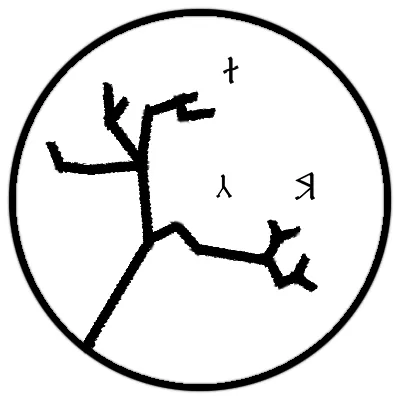
Dictionary
C, Q and X have no rune of their own.17
| Letters | Rune | Notes |
|---|---|---|
| A |  |
|
| Ā |  |
long A |
| B |  |
|
| C | written as K or S | |
| CH |  |
as in church |
| D |  |
|
| DH |  |
the TH of this |
| E | |
|
| Ē |  |
long E |
| F |  |
|
| G |  |
|
| GH |  |
|
| GHW |  |
|
| GW |  |
|
| H |  |
|
| HW |  |
|
| I |  |
also Y |
| J |  |
|
| K |  |
|
| KH |  |
as in loch |
| KHW |  |
|
| KW |  |
also QU |
| L |  |
|
| LH |  |
|
| M |  |
|
| MB |  |
also MH |
| N |  |
| Letters | Rune | Notes |
|---|---|---|
| ND |  or  |
|
| NG |  |
as in sing |
| NG |  |
as in finger |
| NGW |  |
|
| NJ |  |
|
| NW |  |
|
| O |  |
|
| Ō |  or  |
long O |
| Ö |  or  |
|
| P |  |
|
| Q | written as KW | |
| R |  |
|
| RH |  |
|
| S |  or  |
|
| SH |  |
|
| SS |  |
also Z |
| T |  |
|
| TH |  |
as in thin |
| U |  |
|
| Ū |  |
long U |
| Ü |  or  |
|
| V |  |
|
| W |  |
|
| X | written as KS | |
| Y | |
also I |
| Z | |
also SS |
| ZH |  |
as in measure |
Vocabulary
Elvish words and phrases by meaning, in the modern tongue and the archaic.1819
| Meaning | Modern | Archaic |
|---|---|---|
| an act of will, the exercise of will | nirmë | |
| an act or demonstration of love (a deed, testimonial or honor) | immeeira | |
| army of arms (singular akh’velahrn) | Akh’Velahr | |
| army of the art (singular akh’faern) | Akh’Faer | |
| at rest after changing; said of an animal, insect or plant grown to maturity through a life cycle of changes | Sildur | |
| bear | re | graw |
| beautiful, said only of natural beauty, never of people | srendaen | |
| big storm | hethtalos | |
| bisexual female (slang, derogatory) | shaeda | |
| blade (of steel); sword | kerym | macil, megil |
| boy filled with brightness | ivaebhin | |
| cauldron | tammin | |
| changeling | malenti | |
| cloud, clouds | ammur | fanya, lumbo, fân |
| cold illumination of the moon | illunathros | |
| creator races | Iqua’Tel’Quessir | |
| crossdresser (slang) | saece | |
| crystal tower | Cryshal-Tirith | |
| cup (drinking vessel) | aloun | yulma, ylf |
| cup (one’s hands, to hold) | calann | |
| darkness in light | N’landroshien | |
| diamond dew | holimion | |
| dream | ru | olor, lórë |
| drifting (adrift/lost/directionless) | wael | |
| drifting (on air) | vra | |
| drifting (on water) | sathu | |
| elf-friend | Sha’Quessir | |
| endurance beyond hope | bronwe athan harthad | |
| endurance, steadfastness | bronwë, voronwë | |
| evil | vaarn | ulca, naxa, ogol, rhû |
| evil adult elven female | luvaarnele | |
| evil adult human woman | lurvaarnkess | |
| evil entity (sentient being, not divine) | vaarnar | |
| evil female | vaarnelle | |
| an expletive naming a crude bodily function | chi’thall | |
| fair-minded, just, generous | faila, fael | |
| falling rain; tearfall | ileleste | |
| familial love; loyalty to kin and family | immaea | |
| The Far Star | Y’tellarien | |
| a farewell | Sweet water and light laughter until next | namárië |
| fatigued by life’s dark trials | vaendin-thiil | |
| fern | vaerevven | |
| fetid place | cenerea | |
| fire | fete | nár, ruinë, naur |
| firm, true, abiding | thand | |
| flawless | kyre | |
| flower | ama | lótë, alma, loth |
| forest of twilight | Durmista | |
| forsaken; a derisive name surface elves use for drow | irinal | eglan |
| fortunate meeting; a greeting between travelers | AlaE | |
| [may your] fortune bring you joy; an informal greeting or parting between people who enjoy each other’s company. Between close friends it is an insult, or a warning that someone else is listening | Uluvathae | |
| four snows; a period of four years, the same as aeloulaev (plural pyesigeni) | pyesigen | |
| freshwater shallows | vaerve | |
| friend | ravanthas | málo, meldo, mellon |
| garbage; an insult for those of half-elven or human blood | biir | |
| gem | kiir | mírë |
| gem blossom | ilphelkiir | |
| gem flower | amakiir | |
| gift | taran | anna, ann |
| gold petal | xiloscient | |
| grace | lissë | |
| the great art of the people | Arselu’Tel’Quess | |
| hideous prince | tarenbril | |
| high caster; the Art’s disciples | Selu’Taar | |
| high lore gems | Selu’Kiira | |
| Homehaven11 | Aerasumé | |
| homosexual male (slang) | liyan | |
| hunted | aes | |
| it’s good to be alive; a hymn of celebration | Bwaelan Dro | |
| jade | ry | |
| killing | eisliesen | |
| legacy of the north | Noromath | |
| less than half; an insult for humans born to a half-elven parent | zenar | |
| lily | ithlil | indil |
| living tree homes | trazaethe | |
| long-suffering, patience | andreth |
| Meaning | Modern | Archaic |
|---|---|---|
| lore gem (formally tel’kiira) | kiira | |
| love; absence of malice | evae | melmë |
| love; the essence of passion | nor | |
| lovemaking | arkhlavae | |
| lupine; bluebonnet | sormrel | |
| lynx of approaching dusk | walaxyrvaan | |
| the many-splendored | Gwyllachaightaeryll | |
| meadow | rum | |
| memory | ansrivarr | enyalië |
| monstrous spider (plural horbra) | horb | |
| moon | nodel | isil, ithil |
| moon brook | siannodel | |
| moon horse | teu-kelytha | |
| moon whisper | galanodel | |
| murderer | savalir | |
| night breeze | naïlo | |
| noble female elf, by blood, by character or both | etriel | |
| not; a prefix, as in colson, “not-son”, a daughter | col | lá |
| not-people; a derogatory name elves use for those who are not elves | N’Tel’Quess | |
| oaken heel | meliamne | |
| of; a suffix, always contracted when joined to another word | aren | na |
| one land | faerûn | |
| others; modern slang for those who are not elves | aethen | |
| the People; the elves’ name for their own kind | Tel’Quessir | |
| perhaps; modern elven slang | maethe | nai |
| pig (literally, mud-wallowing dogs); sometimes a slur for orcs | slaugh | |
| place of duty | akhiilor | |
| promiscuous female (slang, derogatory) | sreea | |
| rabies | darrdartha | |
| reborn in life’s bright struggles | vaendaan-naes | |
| refuge | relthwin | |
| regal lady; a title for a female ruler | Laranlas | |
| regal lord; a title for a male ruler | Laranlors | |
| ruby | iriador | |
| shadow | guenhwyvar | dae, gwath |
| shadow soldiers (singular n’vaelharn) | N’Vaelhar | |
| shield guardian | aegiskeryn | |
| silver fox | arita | |
| silver frond | liadon | |
| silver hue; moon | teu | |
| sky | lurleath | menel, telumë, vilya |
| someone who enjoys having shapechanging spells cast on them in sexual play (slang, derogatory) | thaethiira | |
| a span of important time, or a generation, depending on context; used to measure a ruler’s reign, and broken down into aeloulaeva and pyesigeni | rysar | |
| spear | rid | hatal |
| spider (plural obra) | orbryn | ungwë, ungol |
| star | rua | elen, él, êl, gil |
| star flower | amastacia | |
| starwing | ruathimaer | |
| storm | huan | raumo, vangwë, gwaew |
| stormclouds, stormfront | huthammur | |
| sun-follower; a breed of horse | Yyllethyn | |
| teacher | aerister | |
| a term of endearment for a sweetheart or a child | damia | |
| those who have their being in the sea haunted by the true dream; a contraction of the longer phrase | asathalfinare | |
| traitor | dhaerow | gurgof |
| transgender | alun | |
| Traveler’s Star | Y’landrothiel | |
| tree warden; one who protects the forest | arakhor | |
| A true friend, as the trees and the water are true friends | Al hond ebrath, uol tath shantar en tath lalala ol hond ebrath | |
| true friend(s) | hond ebrath | |
| unicorn | raer | |
| the valiant | astaldo | |
| the veiled one; a creature whose future is unclear and cannot be divined | talibund | |
| a vile curse or insult | vyshaan | |
| wake | be-inway | |
| warm light of the sun | solicallor | |
| west | ren | númen, andúnë, dûn, annûn |
| when peaces meet; a period of four years, the same as pyesigen (plural aeloulaeva) | aeloulaev | |
| whip, lash | nyrhlas | |
| whipping, lashing | nyrtlassa | |
| white dust | mithardir | |
| winterbreeze | Auglathla | |
| wise-heart | saelind | |
| You hold my heart forever | Ai armiel telere maenen hir | |
| young human male (slang) | bhin |
Drow Language
Deep Drow, the everyday form of the drow dialect, is similar in structure to Common and Undercommon and has taken many words from Orcish, Dwarvish and human tongues.4 Each isolated drow community speaks its own variant, with a distinct accent.20 Deep Drow is written in the Elvish script, read right to left in single-word columns with little punctuation.2120
Most drow know only Deep Drow and their sign language. Adventurers, outcasts, slave-traders and warriors often learn more, and many drow speak Undercommon.4
High Drow is an older, more complex dialect with a larger, runic alphabet. Priestesses use it in their rites, and nobles use it to keep lower-born drow and slaves from understanding them.20 Drow Sign Language is a silent hand code with no written form, read by sight out to about 120 feet.4 Neither can be understood through Elvish alone.
Drow call surface elves darthiir, “traitors”.22 Surface elves call drow irinal, “forsaken”, and the word drow comes from the Elvish dhaerow, “traitor”.18
Dictionary
Drow words and phrases by meaning.222318
| Meaning | Drow |
|---|---|
| a, an | natha |
| about, around | bauth |
| achievement; work completed | xundus |
| agreement, treaty | inthigg |
| aim, goal, hoped-for event | ilindith |
| alert, careful, wary; alertly, carefully, warily | kyone |
| all | jal |
| ally; not-enemy | abban |
| alone, apart | maglust |
| among, into, within | wund |
| and | lueth |
| are | phuul |
| argument, disagreement | qual’laelay |
| as | izil |
| attack from afar; raid | thalackz’hind |
| back (plural ratha) | rath |
| battle-marker; grave | phalar |
| behind | rathrae |
| The best knife is an unseen one | Lil alurl velve zhah lil velkyn uss |
| beware; warning | sarn |
| blade | velve |
| blockage, hitch, snag | kulg |
| blood | qu’lith |
| bold | noe |
| boldly | noet |
| both | tuth |
| bravery, calm, clear thinking, good behavior | honglath |
| brightness, light; as an exclamation, a curse | ssussun |
| a calamari dish | crintishik |
| cast, hurl, throw | luth |
| chosen one (High Drow, from yorn and orthae) | Yor’thae |
| a chosen one of the Goddess; a sacred word | Zedriniset |
| climb | z’orr |
| commanded, ordered | quarthen |
| concealment, shadows; also a common, androgynous name | veldrin |
| conquering, victory; to win, to prevail | ultrinnan |
| conqueror; highest, supreme | ultrin |
| consider; to think | talinth |
| a contest of arms to prove or win innocence | xittalsh |
| continue, continued, continuing, enduring | elendar |
| council, meeting | talthalra |
| damn | straj |
| danger | sreen |
| darkness | oloth |
| Darkness slays light | Oloth elgg ssussun |
| Darkness take you! A common curse | Oloth plynn dos! |
| death | elgghinn |
| death; destroy, kill, slay | elgg |
| deep bat | draghazar |
| deliberate rampart; shield | kulggen |
| destiny | ul-Ilindith |
| destiny; the will of the Goddess | elamshin |
| the destroyer | elgg-hor |
| discover, find, uncover | ragar |
| disrespect; an insult | kaezlen |
| Do as you are ordered, and live | Xun izil dos phuul quarthen, lueth dro |
| doomed | avinsin |
| down, under, below | harl |
| the dream trap; nightmares of the comfort of the mass and the hopeless chaos of individuality | golhyrrl’ fhaazht |
| drow priestess | yathrin |
| drow warrior | sargtlin |
| effort, striving, work | xund |
| encounter; meet | thalra |
| enemy | ogglin |
| Existence is empty without chaos, and life is boring without enemies | drojal zhah obdoluth dorb’d streeak, lueth dro zhah zhaunau dorb’d ogglin |
| expedition; to journey | z’hind |
| fearless, fearlessness; reckless, recklessness | streeaka |
| the fifth course of a banquet | laerazss |
| final, last | shavrak |
| first | ust |
| the first course of a banquet | fore |
| food | caballin |
| fool | wael |
| foolish; unaware, unwary | waela |
| a formal dance, sometimes in costume | illiyitrii |
| the fourth course of a banquet | qonthlo |
| a frenzied dance competition | neideirra |
| from | dal |
| a game popular among drow | sava |
| gift | belbol |
| goblin (plural goln) | gol |
| the Goddess | Quarvalsharess |
| group | akh |
| guarding, waiting, watching | kyorlin |
| guide, key, inspiration | mrimm |
| guts | qu’uente |
| hidden, invisible | velkyn |
| high ones | crinti |
| high priestess | yathtallar |
| History is a poem where all lines rhyme; an old saying on the cyclical nature of life | ava’til natha pasaison zhah ques po finnud ebries herm |
| history, yesteryear | pasaison |
| honored; honored one | malla |
| house | qu’ellar |
| human; one of half-elven blood (plural rivvin) | rivvil |
| I leave you, we leave you; a farewell | aluve |
| I, me; anything referring to oneself | usstan |
| illithid (plural haszakkin) | haszak |
| in | wun |
| in front | alust |
| is | zhah |
| kneel | harl’il’cik |
| learning, wisdom, knowledge | zhaunil |
| liar | uln’hyrr |
| life; to be alive | dro |
| likewise; of course; as you wish | asanque |
| lost, unknown; wanderer | noamuth |
| Meaning | Drow |
|---|---|
| love; an act of love through a sacrificial or noble deed | lurraggath |
| love; an unselfish, deep love | alurlssrin |
| love; the act of love, lovemaking | raggath |
| lower ones | shebali |
| lullaby | vidrinath |
| mad dragon | streeaka droc’uh |
| magic | faer |
| magic item | faerbol |
| magic worker, wizard | faern |
| magical | faerl |
| a male drow (derogatory) | jaluk |
| a male playmate who is not the house patron | parzdiamo |
| master | jabbuk |
| matron (plural ilharressen) | ilharess |
| may, might, perhaps | xal |
| moon (literally silver-light, from alva and ssussun) | alvassun |
| more | mzild |
| mother | ilhar |
| my trusted comrade | khal’abbil |
| no | nau |
| non-drow | colnbluth |
| non-intelligent monster | phindar |
| of | del |
| offal, excrement; an insult for humans and other non-drow | iblith |
| on, upon | pholar |
| one | uss |
| opening, door | obsul |
| outcast | dobluth |
| passion, physical lust, selfish greed, longing, love | ssinssrigg |
| path, known way | colbauth |
| patron | ilharn |
| plan, scheme, stratagem | inth |
| the power, servant or will of the Goddess | yorn |
| power, strength; to dominate by force of will | z’ress |
| promise of a fungal pie; something to sweeten the deal | tinguin lal’o shrome’cak |
| queen; a title for the Goddess and the most powerful matrons | valsharess |
| a rare kind of drow bardic magic | bae’qeshel |
| ruse, trap, trick | golhyrr |
| sacred | orthae |
| scapegoat | pera’dene |
| second | draada |
| the second course of a banquet | vaedrence |
| secret advisor | duvall |
| silver hue | alva |
| the sixth course of a banquet | taerel |
| skill at arms | sargh |
| a small, fierce fish with sharp teeth and powerful jaws, prized as a delicacy | pyrimo |
| something mysterious or intriguing; an unidentified item | bol |
| spider | draugah |
| spider (plural orbb) | orb |
| a spider thought dangerous (plural lhorbbyth) | lhorb |
| spiderweb | orbbcress |
| stealth | olist |
| superior | alur |
| supreme goddess | ultrine |
| supreme warrior | ultrin sargtlin |
| surface elves; traitors | darthiir |
| surprise (plural brorna) | brorn |
| take; to seize | plynn |
| temple | yath |
| than | taga |
| the | lil |
| they, them, their, theirs | nind |
| third | llarnbuss |
| the third course of a banquet | trelvurr |
| those | nindyn |
| three | llar |
| to | ulu |
| to accomplish, to work | xun |
| to be | tlu |
| to command; used in giving an order | quarth |
| to cut | khazid’hea |
| to die in the service of the Goddess; suicide | streea |
| to dodge | bautha |
| to give | belbau |
| to learn, to know | zhaun |
| to play; a game or other amusement | jivvin |
| to pull the legs off a spider; an idiom | kolsen’shea orbb |
| to ride | z’har |
| to walk | z’hin |
| to watch | kyorl |
| torture until death; apparently a cynical twist on the word for play | jivvin quui’elghinn |
| tradition | suuz’chok |
| Trust no one | Khaless nau uss |
| Trust no one more than yourself | khaless nau uss mzild taga dosstan |
| trust; often ironic, for misplaced trust; also a game | khaless |
| trusted friend, trusted comrade | abbil |
| two | draa |
| unholy executioner | duk-tak |
| usual, traditional | elend |
| vengeance | araj |
| war | thalack |
| wealth, coinage, treasure | belaern |
| weirdos | laelar |
| whip, lash | neirt |
| whipping, lashing | neirtarr |
| who | vel’uss |
| a wine made from fermented mushrooms | qilovestualt |
| a woman (derogatory) | elg’caress |
| word | zheel |
| the words of a charm spell, apparently | Angardh xorr feleal |
| you | dos |
| you arrogant fool | usstan’sargh wael |
| your, yours | dosst |
| yourself | dosstan |
History
Session 11
At the Dancing Sword on 30 Coldrise, 1714 PSF, Luma found an inscription in Elvish lettering along the blade of Dorian Draken’s sword that spelled out no Elvish words. Hazel, to whom Elvish script on an enchantment seemed odd, read it from Luma’s copy: it was flowery, poetic Sylvan.14
Session 17
When a man they were chasing slipped past Iva on 7 Nightdeep, 1714 PSF, Hazel called to Luma in Elvish that he had gone south, hoping he did not speak it.8
Session 19
On 9 Nightdeep, 1714 PSF, an argument between Kusa Xungoon and Lamai Tyenmo slipped into a language none of the party spoke. Because Luma speaks Elvish, she could rule out Sylvan.7
Session 20
When something unseen dug into Hazel’s bag in the Canal Markets on 9 Nightdeep, 1714 PSF, she whispered to Luma in Elvish that there was something in it.9
Session 25
Reading Eliath Drace’s map at the Sisters' Farm on 18 Nightdeep, 1714 PSF, Hecate named the city of Aerasumé. Hazel and Luma knew the name as ancient Elvish, no longer in common use, for “Homehaven”.11
Session 26
On 19 Nightdeep, 1714 PSF, the party found Watchman's Gift in the gate of the Ruined Citadel, a longbow inscribed in flowing Elvish script: “For the one who watches”.24
Session 31
On 23 Nightdeep, 1714 PSF, Luma found an X and the Cirth rune for E cut deep into an old oak by a warm stream east of Erhadell, and took them for a surveyor’s mark signed by her great-grandfather, Eliath Drace.5 Mathas Drace said the Cirth E was how Eliath signed all his surveying marks, and the same rune is burned into the cover of Eliath’s field book.5
Session 32
On 25 Nightdeep, 1714 PSF, in a cave in Rainbow Gorge, the party found a circular rune on the blade of the Drace Family Moonblade. Luma worked out from the Cirth chart that two small runes within it are H and V, and Rhysaene saw that the whole rune is the Drace family crest. Neither small rune is the Cirth E that was Eliath Drace’s mark.15 The same day Luma untied a silver ribbon from the sword’s pommel, inscribed in Elvish script, which she could not read: “It’s Elvish script, but it’s definitely not Elvish.” Hazel read it as Sylvan.15
References
Footnotes
-
Player’s Handbook (2024), “Standard Languages”. ↩
-
Forgotten Realms Wiki, “Elven language”. ↩
-
Forgotten Realms Wiki, “Elven dictionary”. ↩ ↩2 ↩3
-
J. R. R. Tolkien’s Quenya and Sindarin, as collected in Paul Strack’s Eldamo, "Elvish Data Model". ↩
-
Forgotten Realms Wiki, “Drow language”. ↩ ↩2 ↩3
-
Out of the Abyss, “The Tower of Vengeance”. ↩
-
Forgotten Realms Wiki, “Drow dictionary”. ↩ ↩2
-
Out of the Abyss, “The City of Spiders”. ↩